On this page
- Building for iPhone only or Android only costs about the same. What you build matters far more than which platform you pick.
- In the US, users are split almost evenly: about 52% iPhone and 48% Android in October 2026, so most businesses need both.
- Two native apps mean two codebases to build and maintain. A cross-platform app (Flutter or React Native) covers both stores from one codebase, which usually costs much less.
- Store costs are small: $99 a year for Apple, a one-time $25 for Google Play, and 15% commission for most small developers on digital sales.
Is Android app development cheaper than iOS? The quick answer
Not really. For the same features, an iPhone app and an Android app take a similar amount of work.
The platform you choose matters much less than how many screens, user roles and integrations the first version has, so the Android app development cost and the iOS app development cost for the same app usually end up close to each other.
The questions that really move the price are whether you need one platform or both, and whether you build them natively (two separate apps) or cross-platform (one codebase for both stores). With WebSeoWiz Tech, a cross-platform app MVP for both the App Store and Google Play starts from $5,999.
Do you need iOS, Android or both?
In the United States the market is close to a 50/50 split. In October 2026, iOS had 51.96% of mobile users and Android 48.02%.1 If you launch on only one platform, you are telling roughly half of your potential customers to wait.
Building for just one platform can still make sense if you know your users. An internal app for a team that all carries company iPhones only needs iOS. An app for drivers or field staff with company Android phones only needs Android. For a customer-facing app in New York, plan for both.
iOS vs Android vs cross-platform app development cost compared
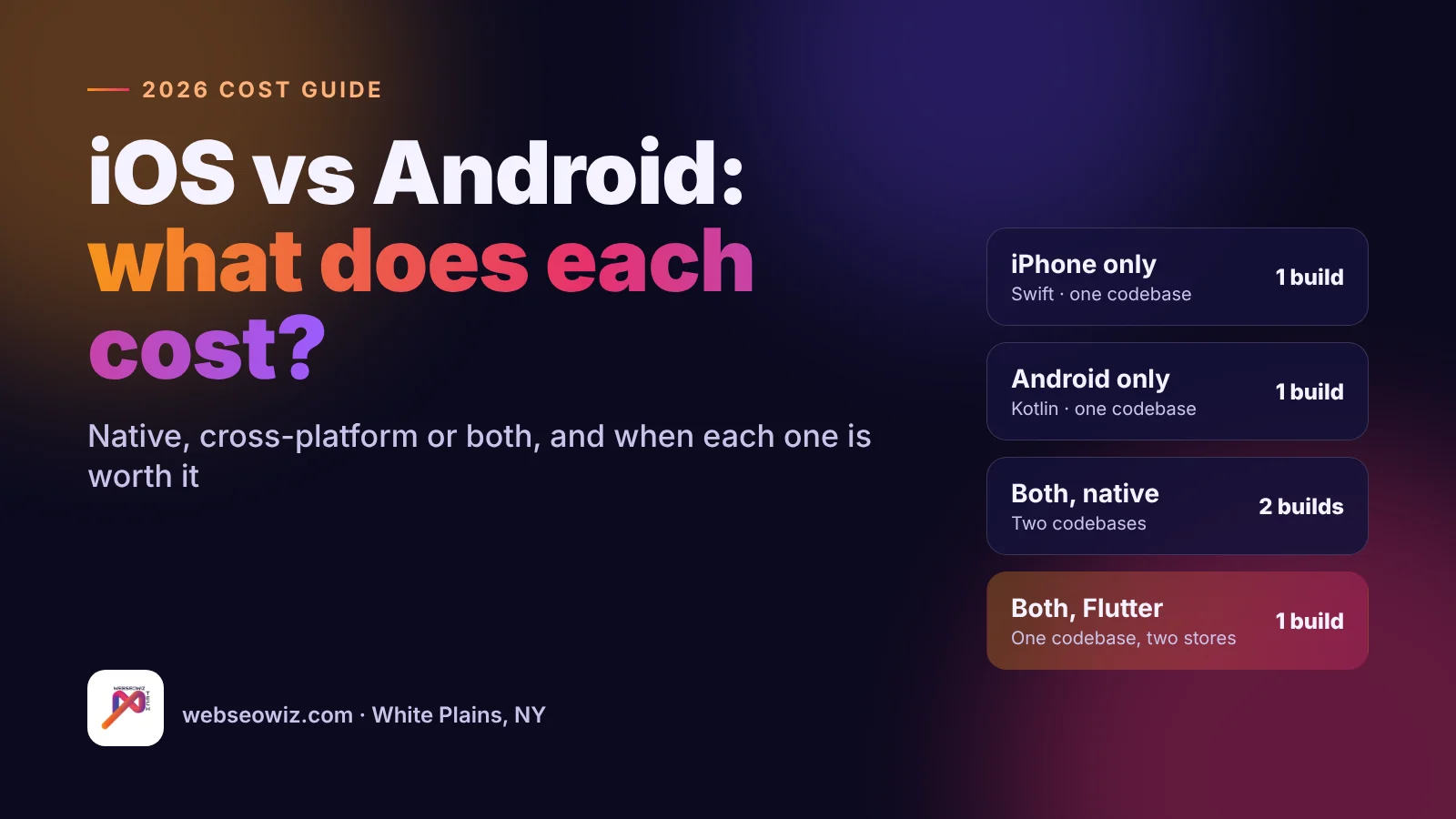
| Option | What you build | Reach | Relative cost |
|---|---|---|---|
| iPhone only (Swift) | One native app | About half of US users | One build |
| Android only (Kotlin) | One native app | About half of US users | One build |
| Both, native | Two separate apps | Everyone | Roughly two builds, and two apps to maintain |
| Both, cross-platform (Flutter) | One codebase, two stores | Everyone | Close to one build, plus some platform-specific work |
How the main build options compare on cost and reach.
That last row is why most small-business apps today are cross-platform: the cross-platform app development cost covers both stores. You reach everyone for close to the cost of one app, and every future update ships to both stores at once.
What makes each platform cost more
- Android: device variety. Android runs on thousands of phone models with different screen sizes and system versions, so testing takes longer.
- iOS: App Store review. Apple reviews every release against its guidelines, and a rejected build needs fixes before it can go live.
- Both: platform features. Widgets, Apple Pay or Google Pay, watch apps and deep camera or Bluetooth features each need platform-specific work.
- Both: design. Making the app feel natural on iPhone and on Android takes extra design time, especially for navigation and system dialogs.
When cross-platform is enough, and when native is worth it
Cross-platform is usually the right choice for booking, ordering, loyalty, customer accounts, payments, field-staff tools and internal business apps. That covers most small-business apps.
Native is worth paying for when the app is graphics-heavy, relies on advanced camera, augmented reality or Bluetooth features, needs maximum performance, or has to use the newest platform features on day one.
If you are unsure, start cross-platform. A well-built Flutter app can still use native code for the one feature that needs it.
App Store and Google Play fees
| Fee | Apple App Store | Google Play |
|---|---|---|
| Developer account | $99 per year | $25 one time |
| Commission on digital sales, small developers | 15% with the Small Business Program (under $1M a year) | 15% on the first $1M a year |
| Subscriptions | 15% for program members, otherwise 15% after the first year | 15% from day one |
Store fees for developers in the US, as of late 2026.
These commissions apply to digital goods such as subscriptions and in-app upgrades.234 If your app sells real-world services or goods, like appointments, food orders or repairs, you take payment through a provider such as Stripe or Square and the store commission does not apply.
Costs after launch on each platform
Apple and Google release new system versions every year, and apps need updates to keep working well on them. With two native apps you update and test twice. With one cross-platform codebase you make the change once and release it to both stores.
Budget for hosting, the store accounts above, and a small monthly amount for updates and fixes. Our mobile app development cost guide covers running costs in more detail.
iPhone and Android apps at WebSeoWiz Tech
WebSeoWiz Tech provides custom iOS and Android app development in New York from our office in White Plains, NY. Most of our apps use one Flutter codebase for both stores, and we build native iPhone and iPad apps in Swift when a project needs deep iOS features.
App MVPs start from $5,999, and native Swift or Kotlin apps are quoted per project after a free call. You get a fixed quote in writing, monthly payments with no interest, and the code and store accounts are yours.
See what we have shipped: PayNex runs on iPhone and Android from one codebase, while Parkovo and Wiz VPN are live on Google Play. Or price your app in 30 seconds.
Frequently asked questions
Is it cheaper to develop an Android app or an iOS app?
For the same features, the cost is about the same. Android needs more testing across devices, and iOS releases go through App Store review, but neither platform is much cheaper to build.
How much does Android application development cost?
With WebSeoWiz Tech, an Android app is usually built together with the iPhone version from one Flutter codebase, so the Android app development price is part of one build, with MVPs from $5,999. A native Kotlin-only Android app is quoted per project.
How much does it cost to build an app for both iPhone and Android?
Two native apps cost roughly twice as much as one. A cross-platform app built with Flutter covers both stores from one codebase. With WebSeoWiz Tech, a cross-platform app MVP starts from $5,999.
Is Flutter good enough for a business app?
Yes, for most business apps such as booking, ordering, loyalty, payments and field-staff tools. Native development is worth it for graphics-heavy apps or apps that depend on advanced camera, AR or Bluetooth features.
How much are the App Store and Google Play fees?
Apple charges $99 a year for a developer account and Google Play charges a one-time $25. On digital sales, most small developers pay 15% commission on both stores.
How much does iOS app development cost in New York?
With WebSeoWiz Tech, iPhone apps are usually built together with Android from one Flutter codebase, with MVPs from $5,999. Native Swift-only apps are quoted per project after a free call.
Sources
- StatCounter, Mobile operating system market share, United States (October 2026)
- Apple, Apple Developer Program membership details
- Google Play Console Help, Get started with Play Console
- RevenueCat, App Store and Google Play fees (updated October 2026)